

After I wrote two blogs here to tell everyone that we have come out 7kw~10kw brushless hub motor with 60V/72V digital controller for electric car and we have modified one gas car to electric.Many friends are interested.
So now I submit the process of modification.Hope it can help everyone to know the diffierence between our electric car and others.
First, check the original rear axle and tear it down.
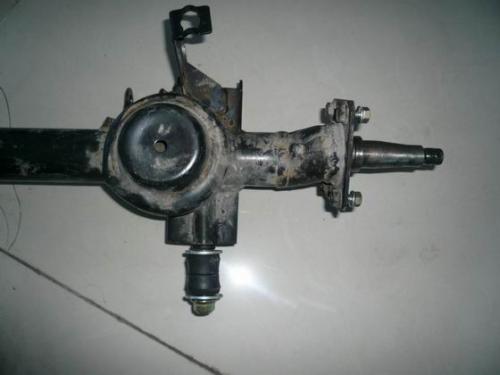
Second,cut two sides of the axle,the length of cut axle is the same as the width of the motor.
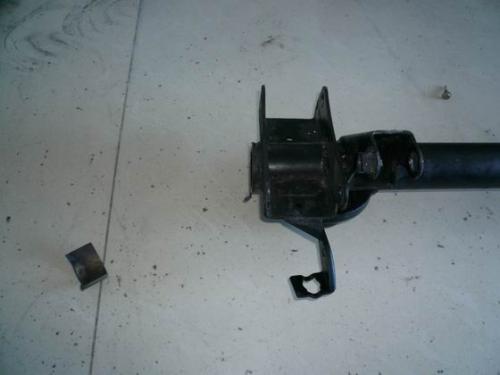
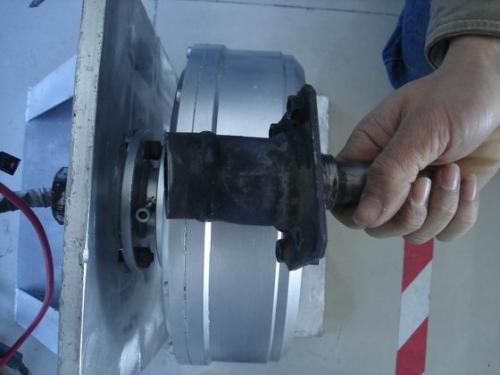
Third,add the frame for assembling the brake and motor to the axle.
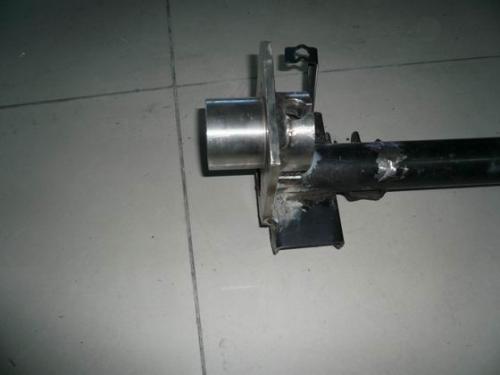
4,Put the brake on.
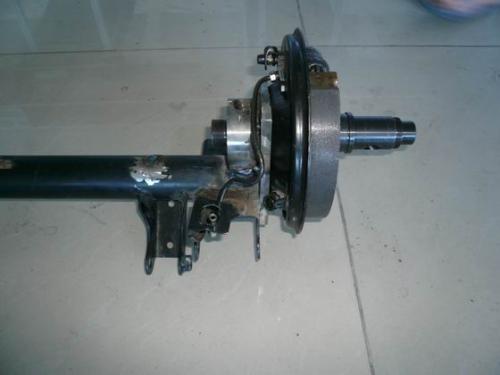
5,Assemble the modified axle to the car.
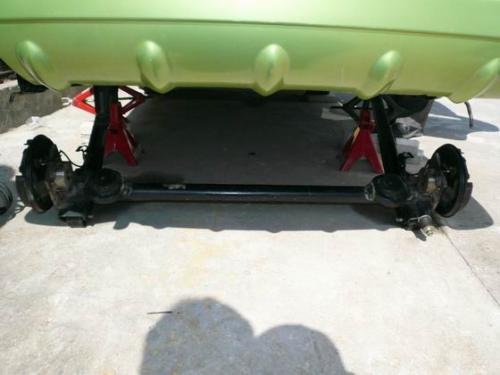
At last,Put the motor to the brake and add the suitable wheel and tire.
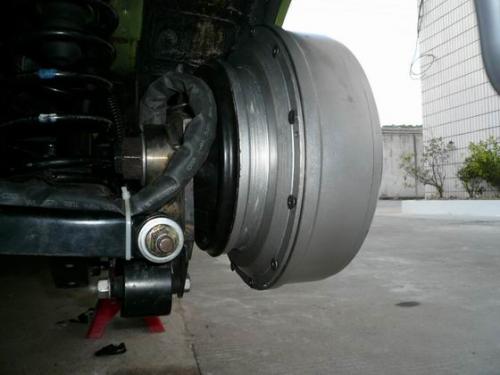
And then,you can drive the pure electric car with max speed of 80km/h on the road easily.
More information of our product,please go to www.emotortech.com
I think this is a good development. Whenever a new component becomes available, garage experimenters can try a variety of things to see what works.
My previous home-made-hybrid donor car of choice was a rare Canadian Pontiac Firefly. It is an All-Wheel-Drive (AWD) Geo Metro. This is a small, light car with a tiny engine which gets good gas mileage.
By removing the shaft connecting the transaxle to the rear differential, an industrial electric motor can be easily adapted onto the rear wheels, with the electric motor being mounted under the rear seat.
The obvious problem is that such a car and rear axle is quite rare. There are now quite literally millions of tiny Front-Wheel-Drive (FWD) cars such as the Chevy Aveo, (made in South Korea)
With the 2008 spike up in gasoline prices there are now quite a few of the compact FWD cars such as the Fit, Yaris, and Versa that have sold well. When tiny cars like this enter the used car market, there will be a flood of experimentation, especially with hubmotors like this being readily available.
I would still prefer a small car with a rear differential and a single motor, but there are simply none available.
Can this hub motor be installed instead of rear wheels which are individually suspended?
I would like to electrify an old Toyoto Camry, keeping the FWD ICE and adding rear wheel electric drive. That way I can use a small battery pack, just enough for a single leg of my commute.
20km range are enough for me if the ICE is still there for when I need it.
This information may be used entirely at your own risk.
There is always a way if there is no other way!
Does anyone understand if / how these hub motors could be attached to all 4 wheels of a car?
Is the installation limited to certain types of axles / wheels / vehicles or can it be used an most wheels?
Can the hub motors be attached to wheels that were not "driven" prior to the EV conversion?
Are certain types of suspensions needed to allow for the extra weight of the motor in the hub?
Thanks,
This information may be used entirely at your own risk.
There is always a way if there is no other way!
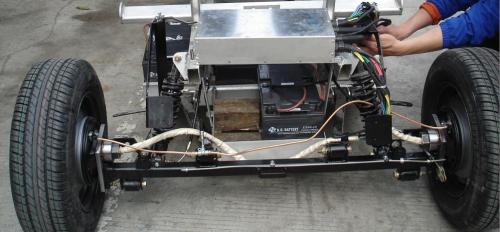
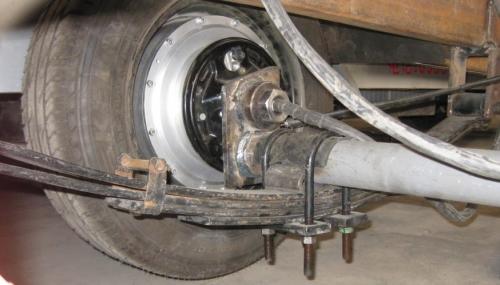
Here are some pictures I was sent by Yolanda. I was hoping to modify a Geo Metro but I have not figured it out yet. They have independent suspension not a strait axle like in the pictures. I would also like to see more speed out of the hub motors.
Eric Fisher
www.SiliconeBatteriesUSA.com
/>
Larger wheels and / or overvolting might fix this low speed problem.
Maybe it is more suited for a SUV kind of vehicle. They can carry more extra weight and have sturdier suspensions.
Their wheels are also larger. Of course the extra weight and wind resistance makes it less efficient.
Or a van! I used to own a Toyota Hiace commuter with LWB and 2.2L diesel engine. It's wheels were slightly larger than car wheels, 62cm diameter instead of 60cm diameter. The circumference is therefore 3.3% increased and the top speed goes up to a whopping 82.6km/h!!! Impressive LOL!
How big are the wheels on a Hummer???
This information may be used entirely at your own risk.
There is always a way if there is no other way!
Here is a link to an interesting discussion about open source wheel motor development:
http://www.diyelectriccar.com/forums/showthread.php/open-source-hub-motor-wheel-motor-14185.html
I've only read the first of many pages, so far it's a great read!
This information may be used entirely at your own risk.
There is always a way if there is no other way!
In theory, converting an existing car to electric by using powerful hub motors sounds like a clever way to go. In practice, the suspension on a normal car is not designed to handle the significant weight increase, and will not work well and could have a catastrophic failure. I read up on some cars that were designed from the start as hub motor cars (like the current Wavecrest prototype)and they had to completely re-engineer the suspension to get it to handle the heavy hub motors unsprung weight.
So it might be OK if you are building a 25 MPH putt putt, not if you are going to have a car with any kind of higher speed capability.
I don't see how the suspension would have to support any added weight as the weight is in the wheel. In this case the car suspension would carry no additional weight.
Eric Fisher
www.SiliconeBatteriesUSA.com
If I can intersperse my uneducated laymans opinion.. the weight difference is that a regular wheel with no hub motor weighs a lot less than a wheel that has a hub motor. That difference has to be accounted for in the suspension.
- David Herron, The Long Tail Pipe, davidherron.com, 7gen.com, What is Reiki
A couple of big powerful hub motors will add over a hundred pounds unsprung weight for the cars suspension to handle. the stresses that puts on control arms, ball joints, suspension bushings, tie rod ends and steering components (if they are in the front), shocks, etc is huge. Traditional car suspensions are not designed for that kind of weight spinning and bouncing around out there only supported by the bushings and joints. Stuff will wear out quickly, and could fail unexpectedly at speed = ouch! For a low speed vehicle, it might be OK. For something that could reach 80 KPH (48 mph) like they say, I don't think it would be a very good idea unless you really beefed everything up like they do on Rally cars or stunt vehicles.
Old thread, with a question left unanswered:
When you replace ordinary wheels with heavier hub motor wheels, you create unsprung weight. What is bad about unsprung weight is that the only way a car has of compensating for bumps wtthout losing the friction patch (Where the tire contacts the road) is by letting the suspension travel up and down, up and down. The heavier the unsprung weight at the hub, the more deflection of the sidewall, the more lifting of the wheel from the road, etc. This not only has immediate negative effects on handling, it stresses the tire and creates the opportunity for sidewall failure.
If you turn your little economy car into an electric with hub motors, keep in mind the effect you have on weight balance. If you put enough batteries under the hood to equal the weight of the missing engine, maybe the transmission if you take that too, you retain handling characteristics, though it would probably change a little because the HEIGHT of the weight also affects this. The slower the car goes, the less of an issue this all is. You can get quite a bit of use out of a car that never gets above 40mph. I have no way of knowing how significant the issue might become at 70mph, it might be slight. If the front is more capable of bouncing with reduced weight, this can join with the unsprung weight to make the car unpredictable.
One other thing: When you take the engine and transmission out of a rear wheel drive car and put the drive motor at the differential, what weight you place where can have a huge impact. Consider the axle line of the front wheel. The engine may weigh more than the transmission, but the transmission is farther from that axle line, creating more leverage. You know how you want to use a longer wrench when you can't loosen that bolt? Also, if the batteries replaceing the extracted weight are higher or lower than what they replace, that changes the roll center. The slower you're going, the less important all this is. At what point disaster will strike it's hard to say. But 2-3 small problems can add up to a bigger issue than one big problem.
WHo dares, WINS!!!!