BMS

Electric Motorcycle Fire: Was It Battery or BMS Problem--Seeking Explanations

How can we determine if our electric motorcycle had a BMS? We imported 2 electric motorcycles in late 2010. They were ordered with a 5000W motor and 72V90AH LiFePO4 battery packs with a BMS. They were routinely charged and test ridden. One bike had about 500 miles. A few weeks ago, it was ridden 20 miles and parked. Approximately 50 minutes after the ignition was turned off, the bike burst into flames and was demolished. Fire marshall determined no signs of foul play. We trying to determine the cause. We are speculating that the battery pack was NOT LiFePO4. We are also speculating that there was no BMS installed, because we cannot find any circuitry between the + and - terminals. How can we verify if there is a BMS? Is there any other way to determine by examining the other bike? We are looking for answers to this safety issue.

Ordering Components

After talking to a fella at EV works about various components I have settled on parts for my bike.

Motor: This is the less complex and slightly more powerful out of the two 48V motors. http://www.evworks.com.au/index.php?product=MOT-MARS-ME0708

Batteries: At the moment I'm getting 11 of these cells and will update later to 16 so I get the full 48V system. These will take about 6 weeks to ship so lots of time to draw up some concepts for attaching them. http://www.evworks.com.au/index.php?product=BAT-LFP60AHA

Controller: This one gives the best acceleration for my price range. http://www.evworks.com.au/index.php?product=CTL-AXE4844

Contactor: Good economical option. http://www.evworks.com.au/index.php?product=REL-ZJW400A

Charger: KP3612EL is not currently stocked so will have to wait for that. The charger will be the only component I will need to replace when changing up to 48V.

Battery Management System: Another component I need to wait for. EV works are developing a new, more compact BMS which should be ready in a couple of weeks.

Braided Cell Interconnectors: http://www.evworks.com.au/index.php?product=BAT-EVW-BCI-60-6

Fuse: http://www.evworks.com.au/index.php?product=FUS-ANN-250

That's all I'm ordering at the moment and these parts, including shipping from Australia to NZ, should cost about NZ$3800 (US$2800). I'll be getting other things like DC-DC converter, gauges, power cable and lugs from an electronics store in NZ once the bike starts to take shape.

Can I run my LiFePO4 Battery with no BMS?

Hello,
I am a newbie who just purchased my first e-bike conversion kit. I picked up the Phoenix 5304 hub motor with a 40 amp controller. The battery been used is a duct tape 48v 20ah pack. I converted my bike and everything worked fine my first time out........until I started to smell smoke :(. I looked over the battery pack it was fine, not even warm. I then inspected the BMS which basically melted. The solder was dripping off the BMS like water!

I did some testing, and believe it or not the BMS still works. After my testing I decided to do the following.

I created harness for the BMS. I am only using the BMS during the charging process. After a complete charge I remove the charger and the BMS via the harness. i then ride the bike with just the battery and an in-line 50 amp fuse. The bike seems to run great. Is this is a safe configuration? Am I in danger of damaging the battery? I assume that the BMS is only used for charging purposes, but I could be WAY off. Thanks for helping the new guy :).

sparc5's picture

Dream GreenSaver Charger - The GreenBMS

I'm moving this from a post to a blog to keep people up to date with my progress.

For those who haven't been following the threads I've posted to here are the problems I'm trying to solve:

1) Battery charging- Make sure our batteries live long and prosper.
2) Equalizing- Make sure they discharge at an equal rate so you're range isn't limited by your weakest battery.
3) Cost- Keep the price lower than the alternatives.
4) Patents- Must do this all without violating patents.
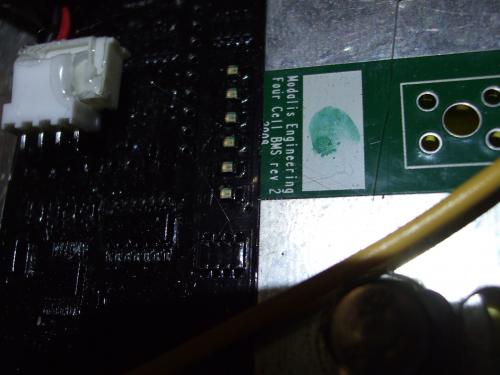
After three weeks of heavy brainstorming here's the leading plan for what I call the GreenBMS:

More than anything, we need a good temperature compensated bank charger. So I'm building a percision, programable, multichemistry, bank charger that uses PWM to provide desulfication and active monitoring of each battery's voltage. Woah, try saying that with one breath (adjusts glasses). This is the heart of the GreenBMS. By using a chip that came to the market only a month ago, you can provide your own DC power source to the charger it can accept anything from 3-75 volts DC. (Anything above 14V means higher efficiency). It is small enough to fit inside the scooter. You can save money by using the charger that came with the bike to power it or buy something beefier. You can even connect it directly to solar panels if you wish.

Extra add-on 1 (An auxiliary battery):

The other benefit to having a power converter that takes such a large range of voltages is you can charge the batteries as you drive, like an alternator does, but it will get it's current from an auxiliary battery instead of a car's engine. You can run the 12V electronics off it and get rid of the inefficient DC-DC converter. The charger will switch to a mode that charges the weakest battery and brings it up to the average state of charge of all the batteries. If the batteries are evenly matched, the auxiliary battery will never discharge much. If all the batteries are very low, or if told to do so, it switches to an extend range mode, where the auxiliary battery charges all the batteries at a rate in which it will be depleted at the same all the other batteries are. When you plug it in, the auxiliary battery gets bank charged with all the other batteries. You can make the auxiliary battery any capacity and chemistry you want. A small cordless power tool battery might be all you need, I need to do testing once I build the prototype. The only cost of this add-on is the price of the battery and the wires to connect it.

Extra add-on 2 (a display, and user interface):

Since the microcontroller (uC) is already monitoring battery voltages, amps, and temperature, it's very simple to display this on an LCD. It will have a graphical user interface and some buttons to let you interact with the BMS' parameters.

Extra add-on 3 (wireless communications):

Everyone can change their programs if they wish to. I know everyone here loves to tinker and share their improvements. I'll offer a long range wireless (102.15.4) data communications add-on so you can program the charger, install updates, monitor the charging, and download data from your rides, from anywhere in your house. It's cheaper than bluetooth, and easier to interface.

This is all going to be opensource to keep costs for everyone to a minimum. I'm doing this project for myself, and making the knowledge on how to do it free for everyone. Early adopters of electric scooters have a soft place in my heart. I'll have extra circuit boards made up, buy enough parts to construct a dozen kits, and sell them in kit form or assembled for a bit extra.

This week I'll be drafting schematics and ordering components.

This project is much more complicated then initially planed. My fears are the cost of the parts, and the complexity of making them all work in harmony. In the past I've programed uC's. I went through a clock making phase. One clock flickered 8 leds fast when you attach it to the ceiling fan it displays the time. I've made a SMPS to power a nixie clock. It turned out well. This time I'll be programming a uC with the most sophisticated program ever. The SMPS this time is powerful enough if I put a wire in the wrong place it could start a fire. If you guys don't hear from me in a while, you can assume I forgot to ground something. :P

As a request: Everyone please take out your multimeters and tell me the resistance of your batteries and voltages before charging and after. Include the temperature as well. Thanks in advance.

-=Jeff=-

Syndicate content

Short URL

Customize This